What Happens to Your Middle Tennessee Business When AI Gets It Wrong
What Happens to Your Middle Tennessee Business When AI Gets It Wrong
By Steve Cory | Cory Media Group | Shelbyville, Tennessee
I want to talk about something that most AI search optimization content never addresses.
What happens when AI recommends the wrong thing about your business.
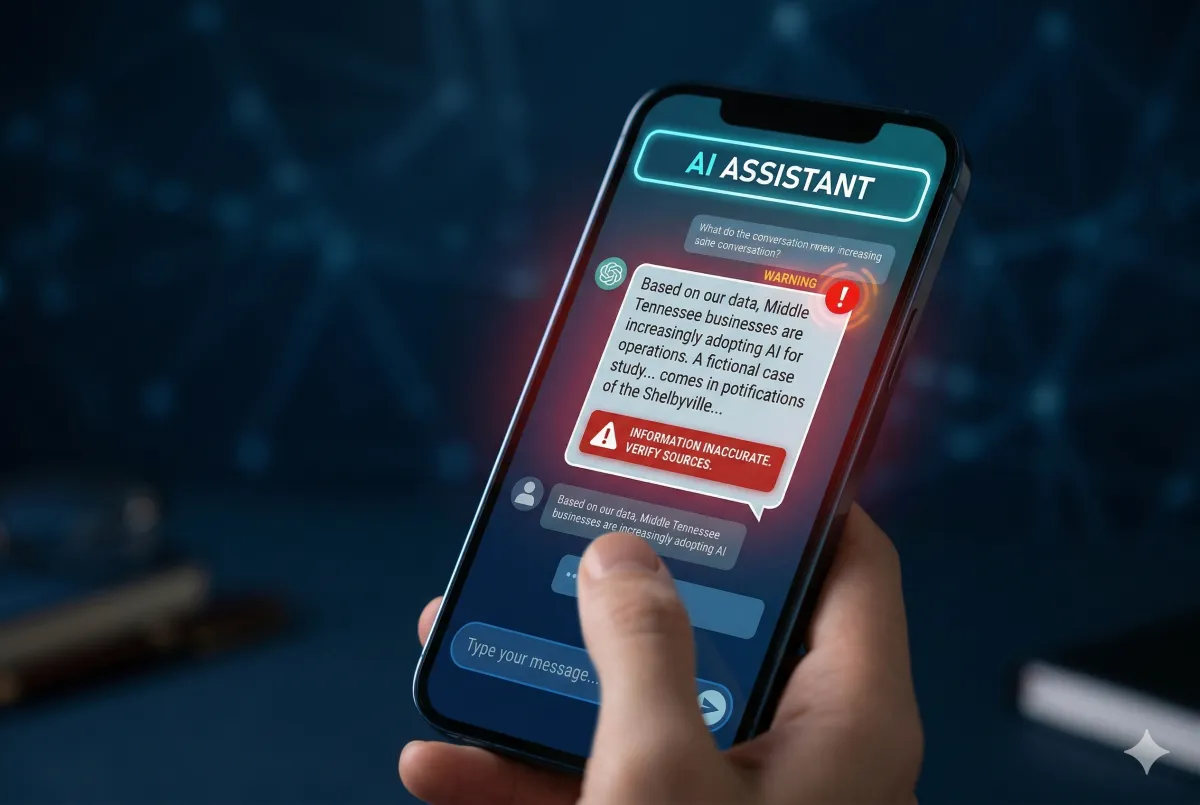
Not when AI fails to recommend you — that's the visibility problem I've covered extensively. But when AI actively says something incorrect about your business. When it recommends you for services you don't offer. When it states hours you don't keep. When it describes your location incorrectly. When it attributes a review to your business that belongs to a competitor with a similar name.
AI gets things wrong about local businesses. Regularly. In ways that cost real customers and create real reputation problems — and most Middle Tennessee business owners have no idea it's happening.
Here's exactly how AI misinformation occurs — and exactly what to do when it happens to your business.
How AI Gets Local Business Information Wrong
Understanding how AI misinformation happens is what makes the correction strategy clear.
AI systems — ChatGPT, Google AI, Perplexity, Apple Intelligence — assemble local business information from multiple sources simultaneously. They cross-reference your GBP, your website, your directory listings, your review profiles, your LinkedIn presence, and dozens of other data points to construct their understanding of your business.
When those sources are consistent — when every platform says the same thing about your business — AI assembles an accurate picture with high confidence.
When those sources are inconsistent or contradictory — when your GBP says one thing, your website says another, and your directory listings say something else — AI does its best to synthesize the conflicting information. Sometimes it gets the synthesis right. Sometimes it doesn't.
And sometimes AI simply hallucinates — generating plausible-sounding information about your business that has no basis in any real data source. AI language models are trained to produce coherent, confident-sounding responses. When they don't have enough accurate information about a specific business they sometimes fill the gaps with generated content that sounds authoritative but is factually wrong.
That hallucinated content — appearing in ChatGPT responses, in Google AI Overviews, in Perplexity citations — is indistinguishable to the consumer from accurate information. It looks exactly like a real AI recommendation. And it can direct customers away from your business, create false expectations that your business then fails to meet, or damage your reputation in ways that are difficult to trace.
The Five Most Common AI Misinformation Patterns for Middle Tennessee Businesses
Pattern One — Incorrect hours or availability.
AI assembles business hours from multiple sources — GBP, website, Yelp, directory listings — and when those sources conflict it makes a judgment call. If your GBP says you close at 6pm but your website still shows the old hours of 8pm from two years ago — AI may generate a recommendation that includes the wrong closing time.
The customer who shows up at 7pm based on an AI recommendation and finds you closed has had a terrible experience that is entirely attributable to a data inconsistency you could have prevented.
Pattern Two — Services you don't offer.
AI sometimes attributes services to businesses based on category associations rather than specific confirmed data. A Murfreesboro plumbing company might be recommended for gas line installation — a service they don't offer — because AI associates plumbing contractors broadly with gas line work.
The customer who calls expecting a service you don't provide has wasted their time and yours — and they're unlikely to leave a positive review about the experience.
Pattern Three — Wrong geographic service area.
AI sometimes expands a business's service area beyond what the business actually serves — particularly for businesses with broad regional names or for businesses that have inconsistent service area information across their digital presence.
A Murfreesboro HVAC company that says "Middle Tennessee" on their website but specifies Rutherford County on their GBP might find AI recommending them for service calls in Williamson County or Bedford County — markets they don't actually serve.
Pattern Four — Confused identity with similarly named businesses.
Businesses with common names — Smith Plumbing, Tennessee Roofing, Murfreesboro Dental — sometimes find AI conflating their information with similarly named businesses in other markets. Reviews, service descriptions, and location information from a different business end up associated with theirs.
This identity confusion can produce AI recommendations that include incorrect phone numbers, incorrect addresses, or incorrect service descriptions — directing customers to the wrong business or creating false impressions about services and quality.
Pattern Five — Outdated information presented as current.
AI training data has a cutoff — and for ChatGPT that cutoff may be months or years in the past. Business information that was accurate at the training cutoff but has since changed — ownership changes, location moves, service additions or removals, hours changes — may continue to appear in ChatGPT recommendations long after the real-world situation has changed.
The customer who calls based on outdated AI information and reaches a disconnected number, a new owner who doesn't recognize the old business's reputation, or a service that was discontinued — has had an experience that damages trust in both your business and in AI recommendations generally.
How to Monitor AI for Misinformation About Your Business
The first step in managing AI misinformation is knowing it exists — which requires active monitoring rather than passive assumption that AI is getting things right.
The monthly AI audit.
Once per month — ideally as part of your AI search metrics review — run the following checks across the four major AI platforms.
Open ChatGPT and ask: "Tell me about [your business name] in [your city] Tennessee." Read the response carefully. Check every factual claim — hours, services, location, phone number, specializations — against what is actually true about your business today.
Open Google AI and search your business name. Read the AI-generated summary that appears. Check every factual claim.
Open Perplexity and search your business name. Read the synthesized response and the citations. Check every factual claim and verify the citations are pointing to accurate information about your business rather than a similarly named competitor.
Ask Siri on an iPhone: "Tell me about [your business name]." Listen to the response. Check every factual claim.
Document every inaccuracy you find. Then address it through the correction strategies below.
The Google Business Profile watch.
Your GBP is the most heavily weighted data source for most AI systems — which means inaccuracies in your GBP produce inaccuracies in AI recommendations faster and more reliably than inaccuracies anywhere else.
Log into your GBP weekly. Check your hours, your services, your phone number, your address, your attributes. Verify that everything shown is accurate and current.
Also check the Q&A section — which any Google user can post to and which AI reads as authoritative business information. Incorrect or misleading questions and answers posted by users can appear in AI recommendations exactly as if they were information you provided.
Respond to every Q&A entry in your GBP — confirming accurate information and correcting inaccurate information — within forty-eight hours of it appearing.
How to Correct AI Misinformation
When you find inaccurate AI information about your business the correction strategy is not to contact OpenAI or Google and ask them to fix it. Those companies don't accept direct corrections from individual businesses for AI-generated content.
The correction strategy is to correct the underlying data sources that AI reads — because when the sources are accurate the AI output becomes accurate over time.
Correct your GBP immediately.
If the inaccuracy traces to incorrect information in your GBP — wrong hours, wrong services, wrong phone number — correct it in your GBP immediately. GBP corrections propagate to Google AI relatively quickly — often within days to weeks depending on Google's re-indexing cycle.
Correct your website and schema markup.
If the inaccuracy reflects outdated website content or incorrect schema markup — correct both. Update the website copy and update the schema to reflect accurate current information. Google re-indexes websites regularly — accurate schema corrections can propagate to AI recommendations within weeks.
Correct your directory listings.
If the inaccuracy traces to incorrect directory listing information — outdated hours, wrong phone number, incorrect service descriptions — audit and correct every major directory. The data aggregator correction strategy — correcting Acxiom, Neustar Localeze, and Data Axle directly — propagates corrections to dozens of dependent directories simultaneously.
Publish corrective content.
When the inaccuracy is significant — wrong services attributed, wrong service area, confused identity with a competitor — publish original content that clearly and specifically states the accurate information.
A blog post that begins "We've noticed some confusion online about what services [your business name] in [your city] actually offers" — and then clearly, specifically, authoritatively describes your actual services — gives AI a clear, current, authoritative content source to draw from in future recommendations.
That corrective content — indexed on your website, shared on LinkedIn, referenced in a GBP post — creates new data signals that correct the misinformation over time.
For ChatGPT specifically — use the feedback mechanism.
ChatGPT has a thumbs down feedback button and a feedback form accessible through that mechanism. When you find a specific inaccurate ChatGPT response about your business — use the feedback mechanism to report the inaccuracy. OpenAI uses this feedback to improve future model outputs.
This doesn't produce an immediate correction — but consistent feedback from businesses whose information is being misrepresented does influence the training data improvements that reduce that specific type of error in future model versions.
The Proactive Prevention Strategy
The most effective management of AI misinformation is prevention — building the kind of consistent, authoritative, regularly updated online presence that gives AI accurate information to work with and reduces the gaps that hallucination fills.
Every element of the AI search optimization strategy I've described throughout this blog series is simultaneously a misinformation prevention strategy.
NAP consistency prevents the conflicting data that produces inaccurate AI synthesis. Schema markup provides structured data that AI reads with high confidence rather than inferring from unstructured content. Regular GBP posting signals to AI that your business information is current and actively maintained. Original content gives AI authoritative source material that crowds out the gaps that hallucination fills.
The business that has built a comprehensive, consistent, regularly updated AI search presence is not immune to AI misinformation — but it is significantly more resistant to it than the business with a thin, inconsistent, rarely updated digital footprint.
Build the presence. Maintain it consistently. Monitor it regularly. Correct promptly when errors appear.
That combination — proactive building, consistent maintenance, active monitoring, prompt correction — is the AI misinformation management strategy that protects your Middle Tennessee business's reputation in the AI search landscape.
Start Here
If you want to know exactly what AI is currently saying about your Middle Tennessee business — and whether any of it is inaccurate — start with our free AI Visibility Scorecard at corymediagroup.com/ai-scorecard.
AI misinformation assessment is part of what we evaluate. You'll know exactly where you stand in minutes.
No sales pitch. No obligation. Just clarity.
Steve Cory is the founder of Cory Media Group, a digital marketing agency based in Shelbyville, Tennessee, helping local businesses across Middle Tennessee monitor, correct, and prevent AI misinformation — and build the authoritative online presence that makes accurate AI recommendations the default.