The Content Flywheel — How One Piece of Middle Tennessee Business Content Can Appear in Five Places Simultaneously
The Content Flywheel — How One Piece of Middle Tennessee Business Content Can Appear in Five Places Simultaneously
By Steve Cory | Cory Media Group | Shelbyville, Tennessee
One of the most common objections I hear from Middle Tennessee business owners when I talk about content marketing is this one.
I don't have time to create content.
And I understand that objection completely. The Murfreesboro HVAC owner who is running three crews, answering service calls, managing inventory, and trying to be home for dinner by seven has no business adding "become a content creator" to their daily task list.
But here's what that business owner is missing — and what changes everything about the content creation conversation.
You don't create five pieces of content. You create one. And then you put it in five places.
That's the content flywheel. And for Middle Tennessee local businesses it's the most time-efficient, most AI-search-effective content strategy available — bar none.
Here's exactly how it works.
The Core Insight
Every piece of content your Middle Tennessee business creates has the potential to appear across five distinct distribution channels — each one producing a different AI search signal, reaching a different segment of your ideal customer audience, and compounding in authority in a different way.
Most Middle Tennessee business owners who do create content put it in one place — a Facebook post, a LinkedIn update, a blog post that nobody reads — and move on.
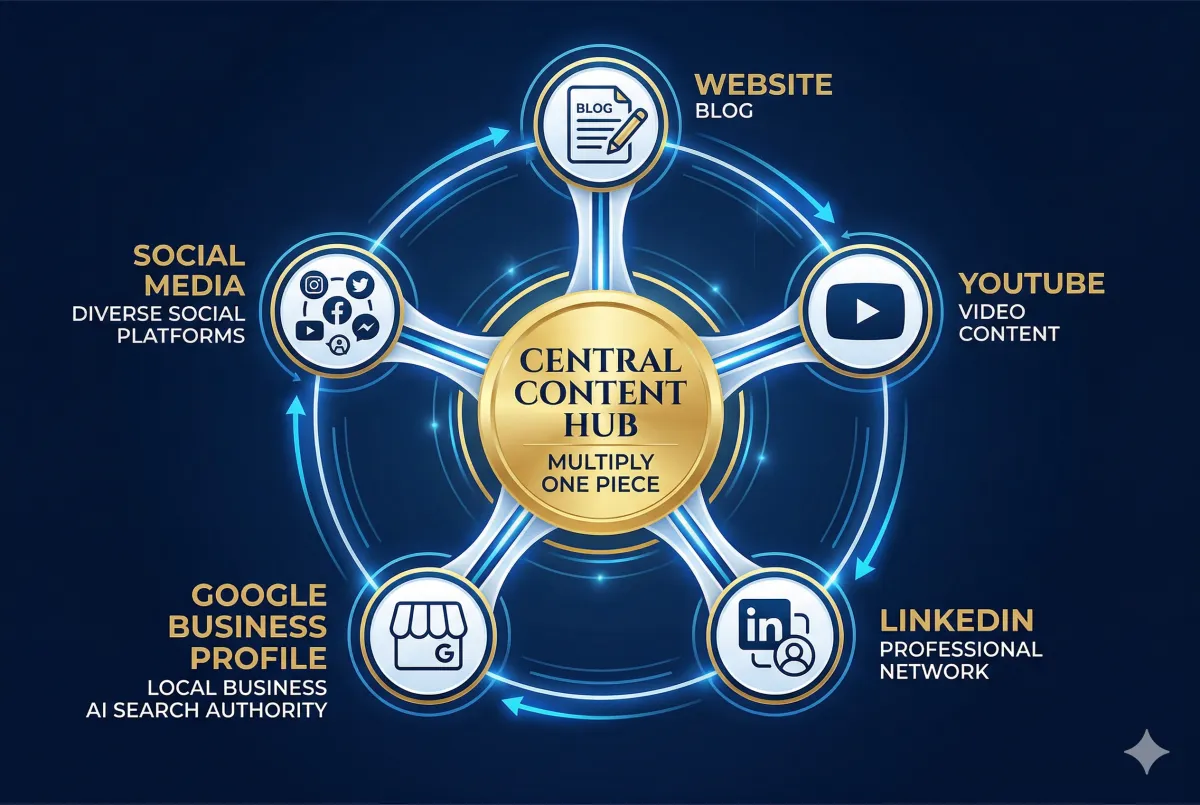
The content flywheel doesn't work that way. It takes one piece of genuinely valuable content and distributes it across every channel simultaneously — multiplying the AI search authority, the audience reach, and the compounding value of a single content creation investment by a factor of five.
One hour of content creation. Five distribution channels. Five AI search signals. Five audience touchpoints. Compounding simultaneously across every platform your ideal Middle Tennessee customer uses.
That's the flywheel. Here's exactly how to run it.
The Five Distribution Channels
Channel One — Your Blog
The blog post is the hub of the content flywheel — the long-form, fully developed version of your content idea that lives permanently on your website, builds domain authority over time, and provides the substantive content that AI search systems read when they're assembling recommendations for the specific topics you cover.
A Murfreesboro HVAC company that publishes a blog post about pre-summer air conditioning maintenance for Rutherford County homeowners has created a permanent web asset — indexed by Google, read by ChatGPT, cited by Perplexity — that produces AI search authority for summer HVAC maintenance queries every year it exists on the site.
The blog post doesn't need to be long. Eight hundred to twelve hundred words of genuinely useful, locally specific content is more valuable than three thousand words of generic information that could apply to any market anywhere.
What it needs to be is specific. The specific seasonal challenges of Middle Tennessee's climate. The specific neighborhoods and communities in Rutherford County where you've done this exact type of work. The specific outcomes your customers experience when they follow your seasonal maintenance guidance.
That specificity is what makes a blog post an AI search asset rather than just content that lives on your website and does nothing.
Channel Two — YouTube
The YouTube video is the visual version of your blog post content — shot simply, published consistently, embedded in the blog post itself to create a richer content asset that reaches the visual learners in your audience and builds the video authority that Google rewards in local search.
Here's what stops most Middle Tennessee business owners from creating YouTube content — the mistaken belief that YouTube videos need to be produced at a high level to be worth publishing.
They don't.
A Murfreesboro HVAC technician standing in front of an air conditioning unit with their phone propped against a toolbox — talking through the specific things homeowners should check before summer arrives in Middle Tennessee — is more valuable to a Rutherford County homeowner than a polished corporate video that could have been filmed anywhere.
The authenticity is the value. The local specificity is the value. The genuine expertise of a person who has worked on hundreds of Rutherford County HVAC systems talking directly to the homeowners in those systems — that's what YouTube rewards with watch time, with subscriptions, and with the local authority signals that compound into AI search visibility over time.
Shoot it with your phone. Keep it under five minutes. Embed it in your blog post. Publish it to YouTube with a description that names your specific services and your specific Middle Tennessee service area.
That's it. The production value is optional. The local expertise is mandatory.
Channel Three — LinkedIn
The LinkedIn article is a professionally adapted version of your blog post content — rewritten for a professional audience, published natively on LinkedIn, and positioned to build the thought leadership authority that produces AI citations for professional queries in your market.
The Murfreesboro HVAC blog post becomes a LinkedIn article about what commercial property managers in Rutherford County need to know before Middle Tennessee's summer heat arrives. The same core content. Different audience. Different framing. Published natively on LinkedIn where it becomes a permanent professional authority asset that ChatGPT and Perplexity can cite.
The LinkedIn article doesn't need to be identical to the blog post — and it shouldn't be. It should be adapted for the professional audience that LinkedIn serves — more analytical, more business-focused, more explicitly positioned around the professional expertise that makes your business the authority in your category for your market.
Link in the first comment. Never in the post body. Every time.
Channel Four — Google Business Profile Post
The GBP post is the condensed, action-oriented version of your blog post content — published to your Google Business Profile to signal to Google and every AI system that reads GBP data that your business is active, engaged, and consistently producing locally relevant content.
The Murfreesboro HVAC blog post becomes a GBP post: "Middle Tennessee summer is coming — is your air conditioning ready? Our Murfreesboro technicians have been servicing Rutherford County homes since [year] and here's what we're seeing in the pre-summer inspection calls. Schedule your AC tune-up before the heat hits. Link in bio."
Under three hundred words. Service-specific language. Location-specific language. Clear call to action. Published the same week as the blog post.
That GBP post — combined with the blog post, the YouTube video, and the LinkedIn article — creates a coordinated content signal across four platforms simultaneously that AI systems read as strong, consistent, locally authoritative activity from an engaged local business.
Channel Five — Facebook Group or Community Content
The Facebook adaptation is the conversational, community-oriented version of your blog post content — adapted for the local Middle Tennessee Facebook groups and community pages where your ideal customers are already gathered.
Not your business Facebook page — where you're talking to an audience that has already found you. The local community groups where your ideal customers are talking to each other.
The Rutherford County Homeowners group. The Murfreesboro Moms group. The Smyrna Community group. The Christiana Neighbors group. The Bedford County local business group.
A brief, conversational post that addresses the same seasonal maintenance topic — from the perspective of a helpful local expert sharing genuinely useful information rather than advertising — reaches exactly the audience you want in exactly the format that Facebook community groups reward.
"Hey Rutherford County homeowners — pre-summer AC tip from a local HVAC tech who has been servicing Middle Tennessee homes since [year]. The number one thing we see in June service calls that could have been prevented in April: [specific tip]. Full guide on the blog if you want the complete pre-summer checklist — link in comments."
That Facebook community post doesn't feel like advertising. It feels like a neighbor sharing useful expertise. And it drives traffic to the blog post — which drives YouTube views — which drives LinkedIn engagement — which drives GBP signals — which drives AI search authority.
The flywheel turns.
The One-Hour Content Creation Process
Here's the specific process for creating one piece of flywheel content — from idea to five-channel distribution — in approximately one hour of total time investment.
Minutes one through fifteen — Core content creation: Write your blog post. Eight hundred to twelve hundred words. One specific topic. One specific local angle. One clear takeaway for your Middle Tennessee ideal customer. Don't edit while you write — get the content down first.
Minutes fifteen through twenty-five — YouTube adaptation: Outline the three to five key points from your blog post. Set up your phone. Record a three to five minute video covering those points in your own voice with your own specific local examples. Transfer to your computer or upload directly from your phone.
Minutes twenty-five through thirty-five — LinkedIn adaptation: Rewrite the core of your blog post for a professional LinkedIn audience. Eight hundred words maximum. Professional framing. Native publication on LinkedIn. Link in first comment pointing to the blog post.
Minutes thirty-five through forty — GBP post: Condense the core message of your blog post into a GBP post. Two hundred words maximum. Service-specific language. Location-specific language. Call to action. Publish immediately.
Minutes forty through forty-five — Facebook community adaptation: Write a brief conversational version of your core message for the local Facebook community groups where your ideal customers gather. One hundred words. Helpful tone. No hard selling. Link in comments to the blog post.
Minutes forty-five through sixty — Publishing and embedding: Publish the blog post with the YouTube video embedded. Confirm the LinkedIn article is live. Confirm the GBP post is published. Drop the Facebook posts in the relevant community groups.
One hour. Five channels. One compounding content flywheel rotation.
The Compounding Math
Here's the math that makes the content flywheel the most time-efficient content strategy available to any Middle Tennessee local business.
One flywheel rotation per week. Fifty-two rotations per year.
At the end of twelve months you have fifty-two blog posts building domain authority on your website. Fifty-two YouTube videos building video authority on your channel. Fifty-two LinkedIn articles building professional thought leadership authority in your category and your market. Two hundred and sixty GBP posts building local activity authority signals across fifty-two weeks. Fifty-two Facebook community touchpoints building local audience relationships across the groups where your ideal customers gather.
That content library — built one rotation at a time, one hour per week — is more AI search authority than most Middle Tennessee competitors will build in five years.
And it compounds. Every piece of content that exists builds on the authority of every piece that came before it. The blog post from week one is still indexed, still building authority, still appearing in AI recommendations — compounded by fifty-one additional posts that have built on top of it.
One hour per week. Fifty-two weeks. A content library that your competitors will spend years trying to replicate.
That's the content flywheel. And for Middle Tennessee local businesses there is no more powerful, no more time-efficient, no more AI-search-effective content strategy available.
Start Here
If you want to know exactly how your current content presence is contributing to your AI search visibility — and what a consistent content flywheel would produce for your specific Middle Tennessee business — start with our free AI Visibility Scorecard at corymediagroup.com/ai-scorecard.
No sales pitch. No obligation. Just clarity.
Steve Cory is the founder of Cory Media Group, a digital marketing agency based in Shelbyville, Tennessee, helping local businesses across Middle Tennessee build the content authority that produces consistent AI search recommendations and genuine market leadership.