How to Get Your Middle Tennessee Business Cited by ChatGPT — A Practical Guide for Local Business Owners
How to Get Your Middle Tennessee Business Cited by ChatGPT — A Practical Guide for Local Business Owners
By Steve Cory | Cory Media Group | Shelbyville, Tennessee
The question I get asked more than any other by Middle Tennessee business owners who understand that AI search is changing their market is this one.
How do I actually get ChatGPT to recommend my business?
It's the right question. And it deserves a direct, practical, non-technical answer — because most of what's been written about ChatGPT and local business visibility is either too abstract to be actionable or too technical to be useful to the business owner who just wants to know what to do this week.
So here's the practical guide. What ChatGPT actually reads when it assembles local business recommendations. What signals matter most. What you can do this week, this month, and this quarter to move your Middle Tennessee business into ChatGPT's consideration set for the queries your ideal customers are asking.
How ChatGPT Actually Makes Local Business Recommendations
Let me explain the specific mechanism — in plain language — because understanding how ChatGPT makes recommendations is what makes every optimization action meaningful rather than arbitrary.
ChatGPT is a large language model trained on an enormous dataset of internet content. That training data includes — among billions of other things — local business information from Google Business Profiles, Yelp listings, directory citations, business websites, LinkedIn profiles, review platforms, and the accumulated content that local businesses have published across the web.
When someone asks ChatGPT for a local business recommendation — "who is the best HVAC company in Murfreesboro Tennessee" — ChatGPT is not performing a live web search in most cases. It's drawing on its training data to assemble a recommendation based on what it learned during training about local businesses in that category and geography.
In ChatGPT's Plus and enterprise versions — which include web browsing capability — it may supplement its training data with live web search results. But even in those cases the businesses that appear most confidently in ChatGPT recommendations are the ones with the strongest underlying training data signals — not just the ones that happen to rank well in a live search at that moment.
This distinction matters for your optimization strategy. Building ChatGPT citation authority is not about gaming a real-time algorithm. It's about building the kind of comprehensive, consistent, specific online presence that produces strong training data signals — signals that tell ChatGPT with confidence that your business is the credible, authoritative, locally relevant answer to the specific queries your ideal customers are asking.
The Seven Signals That Produce ChatGPT Recommendations
Signal One — Google Business Profile authority.
ChatGPT's training data includes significant amounts of Google Business Profile data — and GBP authority is one of the primary signals that produces local business citations in ChatGPT recommendations.
A Murfreesboro HVAC company with a fully optimized GBP — complete service descriptions, weekly posts, active review responses, fresh photos, complete Q&A section — has built a GBP authority signal that appears in ChatGPT's training data as a strong local business citation.
An HVAC company with a minimal, inactive GBP has given ChatGPT's training data almost nothing to work with — which is why it doesn't appear in ChatGPT recommendations regardless of how good its actual service is.
Signal Two — Review volume and language specificity.
ChatGPT reads review content — not just star ratings but the specific language describing specific services in specific locations — as one of its primary local business authority signals.
A Murfreesboro dental practice with 200 reviews containing specific language about family dentistry, insurance panels, new patient experiences, and specific Rutherford County community references has given ChatGPT's training data an extraordinarily rich signal about that practice's specific expertise and geographic authority.
A practice with 15 generic reviews has given ChatGPT almost nothing to work with — which is why review volume and language specificity matter so dramatically for ChatGPT citation frequency.
Signal Three — LinkedIn thought leadership.
LinkedIn is one of the highest-weighted professional content domains in ChatGPT's training data. A Middle Tennessee professional with a strong LinkedIn presence — original articles, consistent posting, local market expertise demonstrated through specific content — appears in ChatGPT's training data as a credible professional authority for their domain and their geography.
A professional with a dormant LinkedIn profile has given ChatGPT's training data no professional authority signal — which is why LinkedIn thought leadership is the single highest-impact content investment available to Middle Tennessee professionals for ChatGPT citation authority.
Signal Four — Website authority and schema markup.
Your website is a primary source in ChatGPT's training data — and the schema markup on your website is how ChatGPT reads your business information in its native structured data format.
A Murfreesboro law firm with a well-developed website — substantive practice area pages, FAQ content, original thought leadership, properly implemented LegalService schema — has given ChatGPT's training data a rich, structured, authoritative signal about the firm's specific expertise and geographic market.
A law firm with a minimal website and no schema markup has given ChatGPT's training data almost nothing to work with for specific legal query recommendations.
Signal Five — Citation consistency across platforms.
ChatGPT's training data includes business information from dozens of platforms — Google, Yelp, BBB, Angi, industry directories, local news mentions, chamber of commerce listings. When that information is consistent — when every platform shows the same business name, address, phone number, and service descriptions — ChatGPT reads the consistency as a strong credibility signal.
When that information is inconsistent — different business names, different addresses, different phone numbers across different platforms — ChatGPT reads the inconsistency as uncertainty and reduces its confidence in recommending that business.
Signal Six — Original content authority.
Original content published consistently across your website, your LinkedIn profile, and your GBP — content that demonstrates specific expertise in a specific domain and a specific geographic market — is one of ChatGPT's strongest local business authority signals.
A Murfreesboro financial advisor who has published twelve original LinkedIn articles about financial planning for Middle Tennessee families, six blog posts about Tennessee-specific tax considerations, and fifty-two weekly GBP posts about financial planning topics relevant to Rutherford County homeowners has built an extraordinary ChatGPT training data signal.
An equally qualified financial advisor who has published nothing has given ChatGPT's training data nothing to cite — regardless of the quality of their actual advice.
Signal Seven — Third-party mentions and citations.
Beyond your own controlled content ChatGPT's training data includes third-party mentions of your business — local news articles, chamber of commerce features, industry publications, community organization websites that reference your business.
Those third-party citations are among the most powerful ChatGPT authority signals because they represent external validation — other authoritative sources confirming your business's existence, credibility, and community presence.
Building third-party citation authority — through chamber of commerce membership and participation, through local news engagement, through industry association involvement, through community sponsorship that generates online mentions — is the citation strategy that compounds most powerfully into ChatGPT recommendation authority over time.
The Ninety-Day ChatGPT Citation Action Plan
Here's the specific ninety-day action plan for building ChatGPT citation authority for a Middle Tennessee local business — organized by impact priority and time investment.
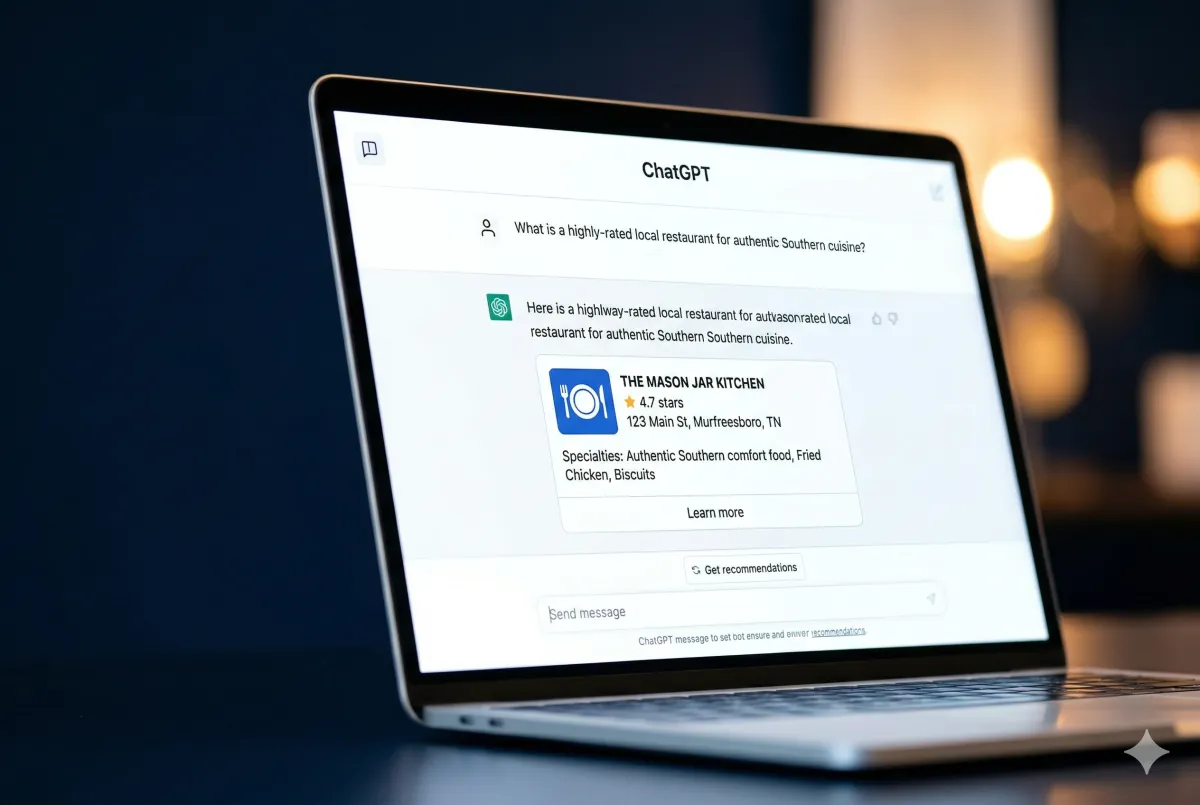
Days one through seven — Foundation audit: Run your business name through ChatGPT right now. Type "who is the best [your business category] in [your city] Tennessee" and read what comes back. Document whether your business appears. Document who does appear. That audit tells you exactly where you stand and who you're competing against for ChatGPT recommendations in your market.
Then audit your GBP, your website schema, your NAP consistency, and your LinkedIn profile against the seven signals above. Document every gap. Prioritize the gaps by impact — GBP and NAP consistency are foundational and should be addressed first.
Days eight through thirty — Foundation correction: Correct every NAP inconsistency you identified in the audit. Complete your GBP with every service, every attribute, every Q&A entry. Implement basic LocalBusiness and Service schema on your website if it doesn't exist. Publish your first LinkedIn article targeting your specific expertise and your specific Middle Tennessee market.
Days thirty-one through sixty — Content acceleration: Establish your LinkedIn posting cadence — two posts per week minimum. Publish your second LinkedIn article. Publish four original blog posts targeting the specific local queries your ideal clients are asking ChatGPT. Begin your weekly GBP posting cadence with service-specific and location-specific content.
Days sixty-one through ninety — Citation building: Join your local chamber of commerce if you haven't. Engage with local business organizations that generate online mentions. Pursue one local media opportunity — a guest article in a local publication, a podcast appearance, a community event sponsorship that generates an online mention with your business name and location.
At day ninety — run the same ChatGPT audit you ran on day one. Search for your business category in your market. Compare the results to your baseline. Document the change.
For most Middle Tennessee businesses that execute this plan consistently — the ChatGPT recommendation landscape will look meaningfully different at day ninety than it did at day one.
The Patience Principle
I want to close with something honest about ChatGPT citation building — because unrealistic expectations are the most common reason Middle Tennessee business owners abandon AI search optimization before it produces results.
ChatGPT citation authority builds slowly. Not because the optimization actions are ineffective — but because ChatGPT's training data doesn't update in real time. The signals you build today — your GBP posts, your LinkedIn articles, your schema markup, your review volume — enter ChatGPT's training data on the update cycle of its training process.
That cycle means the results of your optimization work may not appear in ChatGPT recommendations immediately. They compound over months — which is exactly why starting now rather than waiting produces dramatically better outcomes than starting later.
The Middle Tennessee business owner who builds ChatGPT citation authority consistently over twelve months will find themselves appearing in recommendations that competitors who started six months later are still working toward. That compounding head start — measured in months of training data signals accumulated before the competition — is the most durable competitive advantage available in AI search.
Start now. Build consistently. Trust the compound.
Start Here
If you want to know exactly where your Middle Tennessee business stands in ChatGPT's recommendation landscape right now — start with our free AI Visibility Scorecard at corymediagroup.com/ai-scorecard.
We'll show you exactly where you stand, what's producing results, what's missing, and what to fix first.
No sales pitch. No obligation. Just clarity.
Steve Cory is the founder of Cory Media Group, a digital marketing agency based in Shelbyville, Tennessee, helping local businesses across Middle Tennessee get found, get chosen, and grow in the age of AI search.