
Why Your Google Business Profile Is Dying — And You Don't Even Know It
Why Your Google Business Profile Is Dying — And You Don't Even Know It
By Steve Cory | Cory Media Group | Shelbyville, Tennessee
I want to show you something that most Middle Tennessee business owners have never looked at.
Open Google Maps on your phone right now. Search for your own business. Click on your listing.
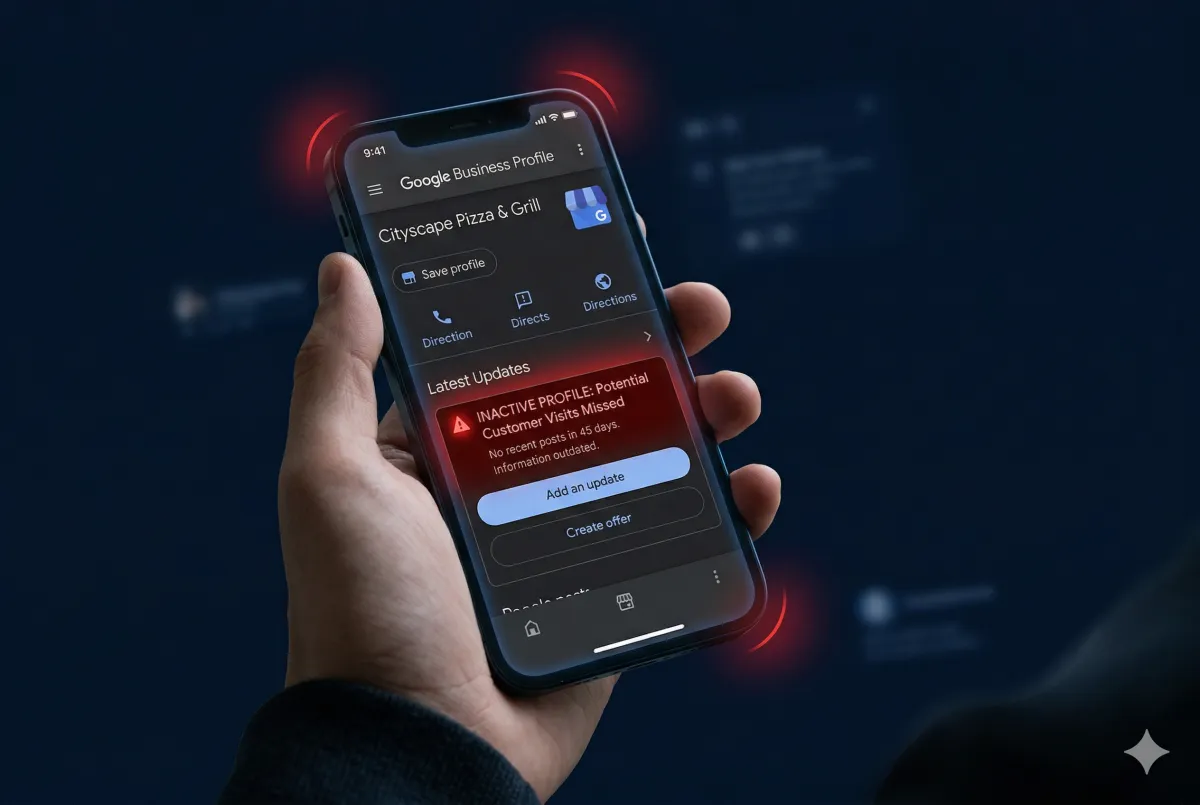
Now scroll down to the section that says "Updates."
When was the last post published?
If the answer is more than thirty days ago — your Google Business Profile is sending a signal to Google and every AI system that reads Google's data that your business is declining.
Not struggling. Not slow. Declining.
That's the signal Google reads from an inactive GBP. And it's a signal that is quietly costing Middle Tennessee businesses new customers every single day — in ways that most business owners never connect back to their GBP inactivity because the damage is invisible until it isn't.
Here's exactly what's happening to your GBP while you're not looking — and exactly what to do about it before the damage compounds further.
The Algorithm Reality Most Business Owners Don't Know
Google's local search algorithm — the system that determines which businesses appear in the local pack, in Google Maps, and in Google AI Overviews — reads GBP activity as a proxy for business health.
The logic is straightforward. Active businesses post. They upload photos. They respond to reviews. They update their hours when they change. They add new services when they offer them. They engage with the Q&A section when customers ask questions.
Declining businesses go quiet.
Google has learned — from analyzing millions of local business profiles against their real-world business outcomes — that GBP activity correlates with business health. An active GBP almost always belongs to a thriving business. A dormant GBP frequently belongs to a business that is struggling, downsizing, or quietly preparing to close.
So Google rewards activity. And punishes inactivity.
Not harshly. Not immediately. Gradually. Compoundingly. In ways that don't produce a single dramatic ranking drop that would alert a business owner to the problem — but that produce a slow, steady erosion of local search visibility that is almost impossible to notice until the phone has been ringing less for six months and nobody can figure out why.
The Three Ways a Dormant GBP Is Killing Your Visibility
Way One — Google stops trusting your business information.
Google cross-references your GBP information against dozens of other data sources — your website, directory listings, social media profiles, third-party citation databases — to verify that your business information is accurate and current.
When your GBP is active — when you're posting regularly, updating photos, responding to reviews — Google reads those activity signals as confirmation that your business is operating and your information is current.
When your GBP goes dormant — when there's no activity for thirty, sixty, ninety days — Google begins to weight your GBP information less confidently. It starts to hedge. To show your business less frequently in searches where it previously showed confidently. To defer to competitors whose active GBPs signal more clearly that their information is current and their business is healthy.
That confidence erosion is invisible from the outside. But it's happening in Google's algorithm every day your GBP sits inactive.
Way Two — AI systems stop citing your business.
ChatGPT, Google AI Overviews, Perplexity, and Apple Intelligence all read GBP data as a primary source for local business recommendations. But they don't just read the static information in your GBP — your name, address, phone number, category. They read the activity signals — the recency of posts, the volume of recent reviews, the freshness of photos.
A GBP with recent activity tells AI systems that this business is currently operating and worth recommending. A GBP with no activity in ninety days tells AI systems that this business may have changed — may have closed, may have reduced hours, may have changed ownership — and should be recommended with less confidence or not at all.
In AI search confidence is everything. AI doesn't recommend businesses it's uncertain about. It recommends businesses whose current status it can verify through recent activity signals.
Your dormant GBP is an uncertainty signal. And AI search doesn't recommend uncertain businesses.
Way Three — Your competitors are compounding while you're standing still.
Here's the most damaging aspect of GBP inactivity — and the one that's hardest to reverse once it takes hold.
While your GBP sits dormant your active competitors are compounding.
Every week they post they add another signal. Every review they respond to adds location-specific and service-specific language to their GBP content. Every photo they upload trains Google's Vision AI to associate their business with specific services in specific locations. Every Q&A answer they add positions them for another conversational AI query.
That compounding activity creates an authority gap — the difference between your dormant GBP and their active one — that grows every week you're not posting. And that authority gap translates directly into AI search visibility that increasingly favors them over you.
The business that has been posting weekly for twelve months has 52 posts of compound authority. You have zero. Closing that gap takes time — time during which their AI search visibility advantage is producing customer relationships that should have been yours.
The Specific Damage a Dormant GBP Produces
Let me be specific about what GBP inactivity actually costs a Middle Tennessee local business — because abstract algorithm descriptions are less motivating than concrete revenue impact.
A Murfreesboro HVAC company with a dormant GBP is invisible to the new Blackman homeowner who asks Google AI for an HVAC recommendation at 11pm when their air conditioning fails. That homeowner calls a competitor whose weekly GBP posts established the authority that produced the AI recommendation.
A Smyrna dental practice with no GBP posts in four months is not appearing in the insurance-specific dental queries that new Nissan plant employees are asking AI before they schedule their first appointment. Those patients are establishing relationships with practices whose active GBPs produced the AI recommendation.
A Lewisburg contractor with a dormant GBP is invisible to the new Marshall County homeowner who asks ChatGPT for a reliable local contractor before the family they know in Murfreesboro has had a chance to give them a referral. That new relationship goes to whoever showed up in the AI answer.
In each case the business lost is not a small loss. It's a new customer relationship — with a new resident who has no established local loyalty — that would have generated years of recurring revenue and referral relationships if the first AI recommendation had gone the right way.
That's what a dormant GBP actually costs. Not a ranking position. A customer relationship.
The Five Signs Your GBP Is in Decline
Sign One — Your last post is more than thirty days old.
This is the most visible and most immediately fixable sign of GBP decline. If you haven't posted in thirty or more days — post today. Right now. Before you finish reading this article. The damage from inactivity compounds with time. Every day you don't post is another day the algorithm reads your silence as a decline signal.
Sign Two — You have unanswered reviews.
Every unanswered review — positive or negative — is a missed opportunity to add service-specific and location-specific language to your GBP content. It's also a trust signal failure — potential customers reading your reviews see unanswered feedback and wonder if the business is still actively engaged with its customer community.
Respond to every review within 48 hours. Every single one. Using the service and location-specific language formula that adds AI search signal to every response.
Sign Three — Your photos are more than six months old.
Google's Vision AI reads the recency of photo uploads alongside the content of the photos. A photo library that hasn't been updated in six months tells the algorithm that your business isn't actively documenting its work — which correlates with the same decline signals that dormant posting produces.
Upload at least one new photo per week. Real work. Real locations. Real authenticity.
Sign Four — Your Q&A section is empty.
An empty Q&A section is a direct AI recommendation opportunity sitting unclaimed. Google's Ask Maps feature — powered by Gemini — draws directly from GBP Q&A sections when answering conversational local queries. An empty Q&A section means you're invisible for an entire category of conversational AI queries that your ideal customers are asking.
Write the ten most common questions your customers ask — in the exact language they use — and answer each one with service-specific and location-specific language. Do it this week.
Sign Five — Your GBP information hasn't been audited recently.
Hours that changed and weren't updated. Services that were added but never reflected in your GBP. A phone number that changed six months ago but still shows the old number in your listing. A service area that reflects where you worked three years ago rather than where you work now.
Outdated GBP information doesn't just hurt your AI search visibility — it actively damages trust when a customer calls a number that doesn't work or arrives during hours that were changed months ago.
Audit every field in your GBP this week. Correct every inaccuracy. Make your GBP reflect exactly what your business is today — not what it was when someone set it up years ago.
The Weekly GBP Routine That Prevents All of This
Here's the complete weekly GBP routine that prevents every one of these decline signals — total time investment approximately thirty minutes per week.
Monday — Write and publish your weekly post. One service spotlight, job completion, community connection, or educational tip. Service-specific language. Location-specific language. Clear call to action.
Tuesday — Upload this week's photo. One real job photo from last week's completed work. Descriptive caption naming the service and the Rutherford County or Middle Tennessee location.
Wednesday — Review response check. Respond to every review received since last Wednesday. Service-specific and location-specific response language. Every review. Without exception.
Friday — Q&A and profile audit. Check for new customer questions. Verify hours, services, and attributes are current. Make any necessary updates.
Thirty minutes. Every week. Fifty-two weeks a year.
That thirty minutes per week — invested consistently, compoundingly, without exception — is the difference between a GBP that is building AI search authority every week and a GBP that is quietly signaling decline while your competitors compound their advantage.
Start Here
If you want to know exactly where your GBP stands right now — and exactly what signals it's sending to Google and every AI system that reads Google's data — start with our free AI Visibility Scorecard at corymediagroup.com/ai-scorecard.
In minutes you'll see exactly where you stand, what's working, what's missing, and what to fix first.
No sales pitch. No obligation. Just clarity.
Steve Cory is the founder of Cory Media Group, a digital marketing agency based in Shelbyville, Tennessee, helping local businesses across Middle Tennessee get found, get chosen, and grow in the age of AI search.