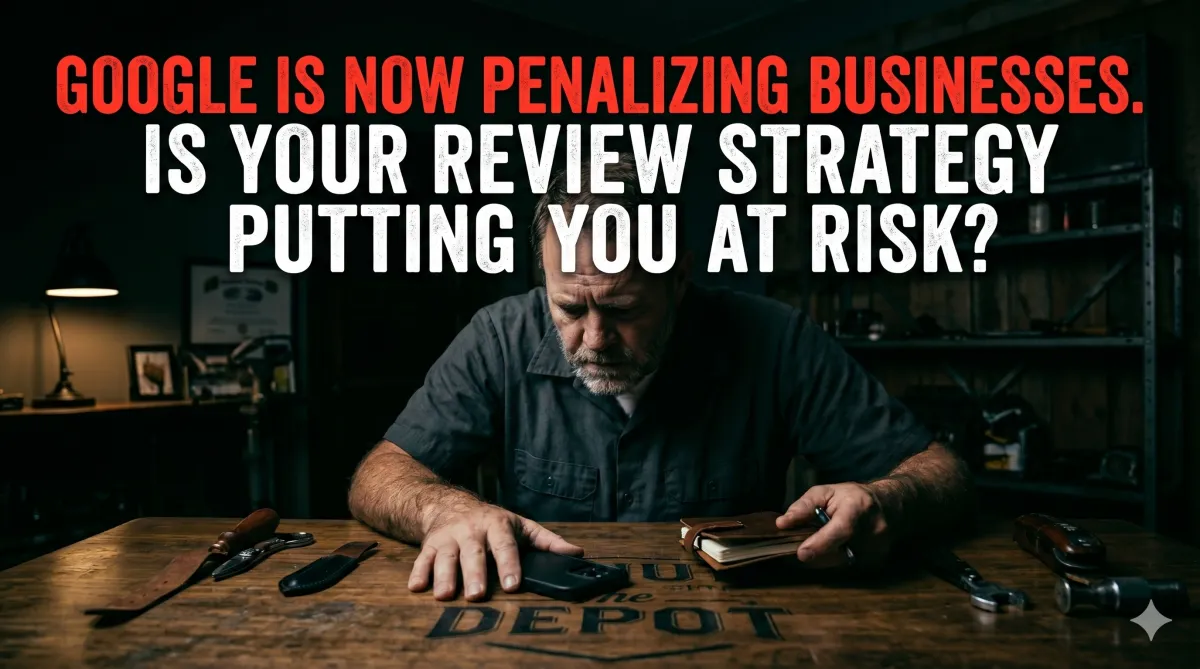
Google Just Changed the Rules on Reviews. Most Middle Tennessee Businesses Don’t Know Yet.
Google Just Changed the Rules on Reviews. Most Middle Tennessee Businesses Don’t Know Yet.
By Steve Cory
On April 17, 2026, Google quietly updated its Prohibited and Restricted Content policy for Google Business Profiles. No press release. No email to business owners. No announcement in your dashboard.
They just changed the rules.
And if you have any kind of review strategy in place right now — a follow-up text, a script your team uses, a process for asking customers what to write — there is a real chance that strategy is now a policy violation.
I’m not writing this to alarm you. I’m writing this because I track this space professionally, and what I’m seeing in the industry right now is a wave of review removals hitting businesses that had no idea anything changed. Legitimate reviews, collected in good faith, gone. Profiles flagged. Rankings quietly dropping.
Here’s everything you need to know — what changed, what’s at risk, and exactly what to do about it.
What Google Actually Changed
The April 17 update added two new clauses to the Maps Rating Manipulation policy. Neither one was explicitly prohibited before. Both are now enforced by AI.
Clause one: Merchants cannot require or pressure customers to leave a review while on the premises. That means in-store kiosks, shared tablets, and any process that asks for a review before the customer has left your location are now explicitly against policy.
Clause two — and this is the one that affects the most businesses: Merchants cannot request that specific content be included in a review.
Not a service name. Not a city. Not a staff member’s name. Nothing specific. The review must come entirely from the customer’s own words.
This is a direct strike at one of the most common review strategies in local marketing: coaching customers on what to write. For years, businesses have been told to ask customers to mention the service performed, their location, and the name of the technician or salesperson who helped them. That practice — in any form — is now a policy violation.
This update did not arrive alone. It came alongside Google’s 2025 Trust and Safety Report, which revealed that Google blocked or removed over 292 million policy-violating reviews in 2025 — roughly 22 percent of all review activity on the platform. The enforcement infrastructure is already built and running. The April 17 update simply expanded what it is authorized to target.
Why This Is Bigger Than a Policy Update
Most businesses will read this and think: “Okay, I’ll stop asking customers to mention the service. No big deal.”
That’s the wrong frame.
The reason this matters so much right now isn’t just compliance. It’s because of what AI systems — ChatGPT, Google’s own AI overview, Siri, Perplexity — actually need from your reviews to recommend your business.
AI doesn’t count your stars. It reads your words.
When someone asks an AI system to recommend the best plumber in Murfreesboro, that system isn’t looking at your star rating. It’s reading the text of your reviews for signals: specific services, specific locations, specific outcomes, specific timeframes. Reviews that say “great service, would recommend” tell AI nothing it can use. Reviews that describe a specific situation — what broke, how it was fixed, when it happened, where — are the ones that get a business recommended by name.
Here’s the tension that makes this so important: the reviews AI needs to recommend you are specific. And the way most businesses have been generating specific reviews — by coaching the content — is now prohibited.
Which means the businesses that figure out how to get specific reviews without coaching them are going to have an enormous competitive advantage over the next twelve months. And the businesses that keep coaching will face two simultaneous problems: policy violations and the quiet removal of their reviews by an AI enforcement system that does not send warning emails.
⚠Real consequence:Google’s enforcement is no longer reactive. Gemini-powered systems now catch prohibited patterns before reviews go live. If your reviews consistently follow a template — same structure, similar phrasing, location keywords in the same position — they are flagged automatically. You will not be notified. They will simply not appear, or disappear from your existing count.
What Is Still Allowed
Before this becomes overwhelming, let’s be clear about what Google’s policy explicitly permits.
Asking for reviews is still allowed. Completely. Google’s own policy states that merchants are permitted to solicit and encourage the posting of content that represents a genuine experience. The restrictions are on how you ask, who you ask, and what you ask for.
A compliant review process in 2026 looks like this:
•Send a follow-up text or email to every customer after a completed service — not just the happy ones. Review gating (only asking customers you think are satisfied) is a separate, actively enforced violation.
•Keep the ask completely open-ended. “If you’d be willing to share your experience, it would mean a lot” is compliant. “Mention the service and the city” is not.
•Do not ask on-premises. Wait until the customer has left, then follow up by text or email. Same-day or next-day is fine.
•Respond to every review with specificity. Your response as the business owner can include the service, the location, and the outcome. That is not coaching the reviewer — that is your voice as the operator, and it reinforces the same signals AI needs.
That last point is worth pausing on. When you respond to a review and write “Thank you for trusting us with your water heater replacement in Murfreesboro — we’re glad we got it resolved same day”, you have just added location and service language to that review thread. AI reads your responses. You are not manipulating the customer’s words. You are adding your own. That is compliant, and it matters.
The Deeper Fix: The Experience Writes the Review
Here is the insight that separates the businesses that are going to win this from the ones that are going to spend the next year confused about why their reviews keep disappearing.
You cannot coach a specific review anymore. But you can deliver an experience so specific, so detailed, so memorable — that the customer describes it specifically on their own.
Think about the last time you left a detailed, specific review for a business. Not a “great service” review — a real one, with detail. What prompted it?
Almost certainly, something specific happened. The technician explained exactly what was wrong and why. The salesperson remembered something personal from a previous visit. The doctor spent fifteen minutes walking through the diagnosis instead of rushing out the door. The specificity of your experience gave you something worth saying.
That is the lever businesses need to pull right now. Not a better review script. A better customer experience — specifically, a more narrated one.
Train your team to narrate the job. Explain the diagnosis. Name the part that failed. Describe the outcome in terms the customer can repeat. Not because you’re building a script for their review — because that is what a genuinely excellent service experience looks like. The customer who understands what happened to their HVAC system, why it happened, and how it was fixed has a story. And stories are what AI needs.
This is the shift that the updated policy is actually forcing. Google is pushing businesses toward a model where review quality is downstream of service quality — not downstream of marketing strategy. The businesses that operate that way naturally are going to find that this policy change barely affects them. The businesses that have been manufacturing the appearance of that quality are the ones in trouble.
What to Do Right Now
If you are a Middle Tennessee business owner reading this, here are the four things to do this week.
First — audit your current review process. If you have any templated messaging that includes guidance on what to write, update it immediately. This includes scripts your front desk uses, automated follow-up texts that suggest keywords, and any reputation management software that pre-screens customers by sentiment before sending a review link.
Second — audit your existing reviews. Pull up your Google Business Profile and look at your last twenty reviews. Are they following a pattern? Similar structure, similar keywords, similar phrasing? If so, those reviews are at elevated risk of removal under the new AI enforcement. You cannot undo what’s already posted, but you can stop adding to the pattern.
Third — change the ask. Strip it down to its simplest form. Something like: “Hey, if you’d be willing to share your experience online, it would mean the world to us — just tell it the way you’d tell a friend.” That is compliant. That is enough. The specificity has to come from the experience itself, not the prompt.
Fourth — start responding to every review with location and service specificity. This is the most underused compliant lever available to local businesses right now. Your responses are indexed. AI reads them. Use every response to reinforce who you are, what you did, and where you did it. In your own words, as the business owner. That is not coaching. That is your voice.
The Bigger Picture
This policy change is not an isolated event. It is part of a larger shift in how AI systems evaluate local business credibility.
Traditional SEO was a keyword game. Feed the algorithm the right words in the right places, and you ranked. That logic is what drove coached reviews — more keywords in the review text, better signals to the algorithm.
Generative Engine Optimization — the framework I teach and build for local businesses — operates on a different premise entirely. AI systems do not match keywords. They evaluate credibility. And credibility, to an AI system, is about whether the signals across your entire digital presence are consistent, specific, and authentic.
Coached reviews that follow a template are, by definition, inauthentic. AI systems are now explicitly built to detect and remove them. Google’s April 2026 update did not create this reality — it simply made the prohibition explicit and expanded the enforcement.
The businesses that own local AI search over the next five years are the ones building authentic digital infrastructure right now. Not the ones gaming a system that no longer exists.
If you want to know where your business stands across all five layers of GEO — including how AI is currently reading your review language — the AI Visibility Scorecard below takes about ten minutes and shows you exactly what you’re working with.
It’s free. And given what just changed, this week is a good time to run it.
See how your business ranks here>
Find Out How AI Is Reading Your Business Right Now
The free AI Visibility Scorecard audits all five GEO layers — including your review language — in about 10 minutes. You’ll know exactly where you stand and what to fix first.