The Review Generation System — How Middle Tennessee Businesses Can Build the AI Search Fuel That Competitors Can't Buy
The Review Generation System — How Middle Tennessee Businesses Can Build the AI Search Fuel That Competitors Can't Buy
By Steve Cory | Cory Media Group | Shelbyville, Tennessee
I want to tell you about the single most underutilized AI search asset available to any Middle Tennessee local business.
Not schema markup. Not LinkedIn thought leadership. Not GBP posting cadence.
Customer reviews.
Specifically — the specific language inside customer reviews. The words your satisfied customers use to describe your services, your location, your outcomes. The sentences that — when written with the right specificity — become direct AI search signals that match your business against the conversational queries your ideal customers are asking.
Most Middle Tennessee businesses have reviews. Almost none of them have built a systematic process for generating the kind of review language that actually drives AI search recommendations.
Here's exactly what the difference looks like — and exactly how to build the review generation system that produces the AI search fuel your competitors can't buy.
Why Most Reviews Are AI Search Worthless
Let me be direct about something that most marketing conversations avoid saying out loud.
Most positive reviews are nearly worthless for AI search purposes.
Not worthless for social proof. Not worthless for the human visitor who scans your Google profile before calling. Those generic positive reviews do a perfectly adequate job of reassuring potential customers that other people liked working with you.
But for AI search — for the specific mechanism by which ChatGPT and Google AI and Perplexity assemble local business recommendations — most reviews provide almost no usable signal.
"Great company." "Very professional." "Highly recommend." "Five stars."
AI reads those phrases and learns almost nothing it can use to match your business against a specific local query. It doesn't learn what specific service you performed. It doesn't learn where you performed it. It doesn't learn what specific outcome you produced. It doesn't learn what specific type of customer you served.
It learns that someone liked working with you. Which is nice. But it's not the AI search signal that produces recommendations.
The AI search signal that produces recommendations looks like this instead.
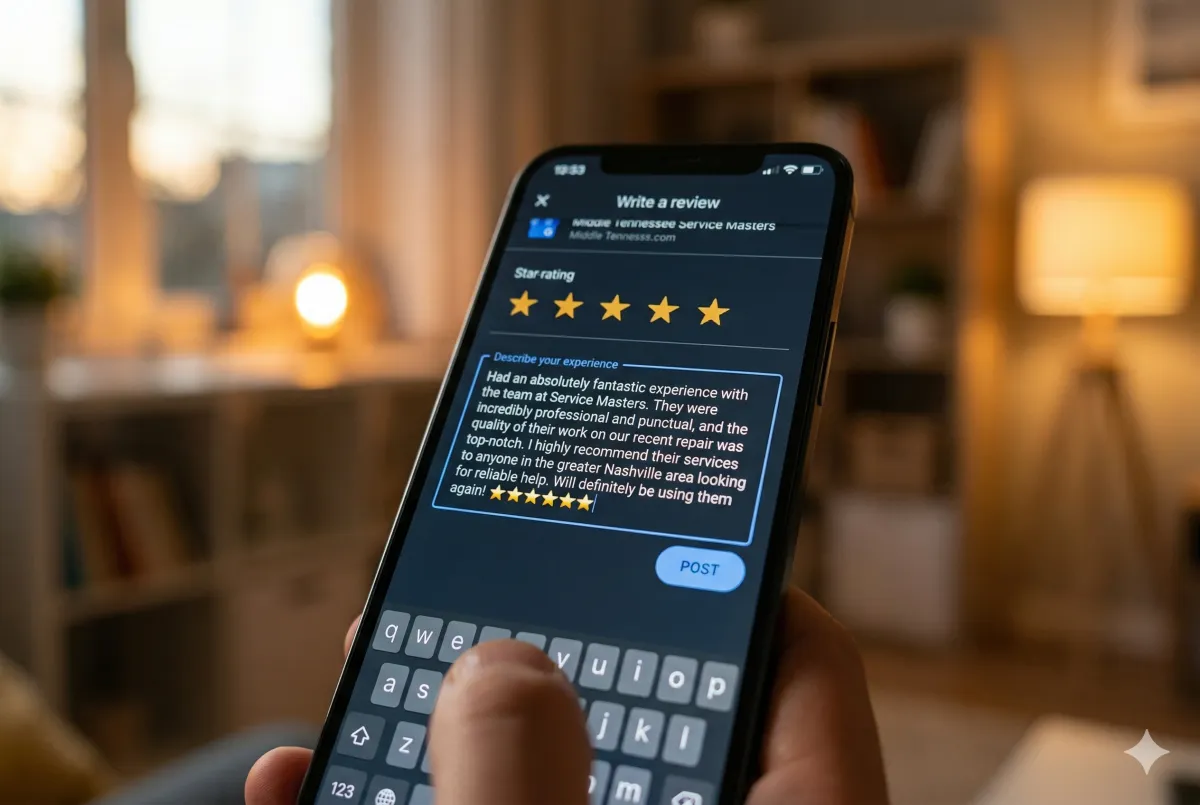
"Had a complete electrical panel upgrade at our home in the Blackman area of Murfreesboro — the team arrived on time, completed the work in one day, passed inspection on the first visit, and charged exactly what they quoted. As new homeowners in Rutherford County without any established local electrical contractor we found this company through Google and couldn't be happier. Best licensed electrician in Murfreesboro for residential panel upgrades."
That review mentions panel upgrade, Blackman, Murfreesboro, one-day completion, inspection pass, accurate quote, new homeowners, Rutherford County, Google discovery, and licensed electrician. It's a comprehensive AI search signal that matches against electrical panel upgrade queries from the Blackman area from new Rutherford County homeowners.
The difference between those two reviews is not the sentiment — both are positive. The difference is the specificity. And that specificity is entirely within your control — if you build the right review generation system.
Why Review Generation Is a System Not an Ask
Here's the fundamental mistake that most Middle Tennessee businesses make with review generation — they treat it as an ask rather than a system.
The ask approach: remember to ask happy customers for reviews when you think of it, hope they follow through, accept whatever language they choose to use.
The system approach: a defined process that prompts every customer at the right moment with the right question through the right channel — producing consistent review volume with consistent language specificity as a predictable output of normal business operations.
The ask produces sporadic reviews with generic language. The system produces consistent reviews with specific language. And in AI search consistent specific reviews compound into authority that sporadic generic reviews never achieve.
Here's exactly how to build the system.
The Four Elements of an Effective Review Generation System
Element One — The Right Moment
Timing matters more than most business owners realize. The moment a customer is most likely to leave a specific, enthusiastic review is not three days after the job is complete when the experience has faded into routine. It's immediately after the peak positive moment — the moment of maximum satisfaction and minimum friction.
For a Murfreesboro HVAC company that moment is when the technician completes the service call and the homeowner first feels the cool air — before the technician has left the property.
For a Rutherford County dental practice that moment is when the patient is checking out after a successful appointment and their anxiety has been replaced by relief.
For a Murfreesboro contractor that moment is when the homeowner walks through the completed project for the first time and sees the transformation.
Identify the peak positive moment in your specific customer experience. That's when you ask. Not later. Not in a follow-up email three days later. In the moment of maximum satisfaction.
Element Two — The Right Question
This is the element that most Middle Tennessee businesses are getting completely wrong — and that is the single biggest lever for improving review language specificity.
Most businesses ask: "Would you mind leaving us a Google review?"
That question produces whatever the customer chooses to write — which is almost always generic because the customer has no guidance about what would actually be useful.
The right question prompts specific language without dictating it.
"We'd really appreciate it if you could leave us a Google review — and if you could mention the specific work we did and where your property is located it helps other Rutherford County homeowners find us when they're searching for the same service. Would that be okay?"
That prompt — specific work, specific location — produces the service-specific and location-specific language that drives AI search recommendations. Without dictating the review. Without putting words in the customer's mouth. Just directing their attention to the details that are most useful.
For high-ticket or high-emotion service categories — healthcare, legal, financial — the prompt adapts accordingly.
"We'd really appreciate a Google review — and if you could describe what brought you to us and what the experience of working with our team was like it helps other [Rutherford County families / Murfreesboro business owners / new Tennessee residents] find us when they're in a similar situation."
That prompt — what brought you to us, what the experience was like — produces the situation-specific and outcome-specific language that AI search rewards in professional service categories.
Element Three — The Right Channel
The review request channel — how you deliver the ask — determines the friction level the customer experiences in responding. Lower friction produces higher response rates.
The lowest-friction review generation channel for most Middle Tennessee local businesses is the text message with a direct link.
A text message sent within minutes of the service completion — to the phone number the customer provided — with a brief message and a direct link to your Google review page eliminates every step between the customer's intention to leave a review and the completion of that review.
"Hi [name] — thank you for choosing [business name] for your [specific service] today. If you have a moment we'd really appreciate a Google review. Direct link: [shortened Google review URL]. Even a sentence about your experience helps other [Rutherford County homeowners / Murfreesboro families] find us!"
That text — sent within fifteen minutes of service completion, direct link included, brief and personal — produces response rates that email follow-ups three days later simply cannot match.
Element Four — The Right Follow-Through
Review generation systems fail most commonly not at the ask but at the follow-through. The customer intends to leave a review. They get busy. The link gets buried in their messages. Three days later the intention has evaporated.
A single follow-up — sent forty-eight hours after the initial ask if no review has appeared — recovers a significant percentage of the customers who intended to review but didn't follow through.
"Hi [name] — just following up on the review request from [service day]. If you have two minutes your feedback really does make a difference for other [Rutherford County homeowners] searching for [service category]. Direct link again: [link]. Thank you!"
Brief. Personal. Non-pushy. One follow-up only. That single recovery text turns a significant percentage of unrealized review intentions into published reviews.
The Review Response System
Generating reviews is half of the review system. Responding to them is the other half — and it's the half that most Middle Tennessee businesses are almost completely ignoring.
Here's what most business owners don't know about review responses.
They're indexed by Google. Read by AI. Weighted as content signals in local business recommendations.
A review response that says "Thanks so much for the kind words!" is a missed opportunity. A review response that says "Thank you [name] for trusting us with your electrical panel upgrade in the Blackman neighborhood — passing inspection on the first visit is something we're committed to for every Rutherford County homeowner we serve" is a ranking signal.
Every review response is an opportunity to add service-specific and location-specific language to your Google Business Profile — language that AI reads alongside the original review and weights in your recommendation score.
The review response formula that produces AI search signals:
Thank the customer by name. Reference the specific service they received. Reference the specific location. Restate your commitment to that service standard. Keep it under seventy-five words.
"Thank you [name] for trusting [business name] with your [specific service] in [specific location]. [Service-specific outcome statement]. Serving [geographic area] [customer type] with [specific quality standard] is exactly what we built this business to do. We look forward to being your [service category] in [location] for years to come."
Apply that formula to every review — positive and negative — within forty-eight hours. Every single one. Without exception.
The Negative Review Response
Let me address negative reviews specifically — because most Middle Tennessee business owners handle them in ways that actively harm their AI search visibility rather than protecting it.
The wrong response to a negative review: defensive, emotional, blame-shifting, or completely generic.
The right response to a negative review is the most important review response you'll ever write — because potential customers reading negative reviews are specifically evaluating how you handle problems. And AI systems read negative review responses as signals of business accountability and customer service commitment.
The formula for a negative review response:
Acknowledge the specific concern without defensiveness. Express genuine commitment to making it right. Invite the customer to contact you directly to resolve the situation. Keep it brief — under fifty words.
"[Name] — thank you for sharing this feedback. What you've described doesn't reflect the standard we hold ourselves to for every [Rutherford County] customer. Please contact us directly at [phone/email] so we can make this right. We take every customer experience seriously and want the opportunity to resolve this."
That response — calm, accountable, resolution-focused — tells every potential customer reading it that this business takes problems seriously. And it tells AI systems that this business is actively engaged with its customer community rather than ignoring feedback.
The Review Generation Calendar
Here's the specific weekly routine for maintaining consistent review generation — total time investment approximately fifteen minutes per week.
Monday — Check your Google profile for new reviews from last week. Respond to every review using the formula above within forty-eight hours of publication.
Wednesday — Review your service completion list from the previous week. Send the text message review request to every customer who hasn't yet left a review and whose forty-eight-hour follow-up window has passed.
Friday — Check for new reviews that appeared after Wednesday's check. Respond immediately.
Fifteen minutes per week. Every week. Fifty-two weeks per year.
That routine — executed consistently — produces a review profile that compounds in volume, in language specificity, and in AI search authority every week it runs.
The Compound Effect
Let me close with the specific math that makes review generation the most compounding AI search investment available to any Middle Tennessee local business.
A business that generates three new reviews per week — through a consistent system rather than sporadic asking — generates one hundred and fifty-six new reviews per year.
At the end of year one that business has one hundred and fifty-six reviews with service-specific and location-specific language — a review authority profile that produces confident AI recommendations across the full range of specific queries their ideal customers are asking.
At the end of year three — four hundred and sixty-eight reviews. An AI search authority signal so deep and so consistent that no competitor who started their review generation system after year one can overcome it without years of catch-up.
The compound effect of consistent review generation — built systematically, maintained consistently, responded to with AI-optimized language — is one of the most durable competitive advantages available to any Middle Tennessee local business.
Start the system this week.
Start Here
If you want to know exactly how your current review profile is contributing to your AI search visibility — and what a systematic review generation process would produce for your specific Middle Tennessee business — start with our free AI Visibility Scorecard at corymediagroup.com/ai-scorecard.
No sales pitch. No obligation. Just clarity.
Steve Cory is the founder of Cory Media Group, a digital marketing agency based in Shelbyville, Tennessee, helping local businesses across Middle Tennessee build the review authority that produces consistent AI search recommendations and genuine market leadership.