
How Thompsons Station Is Becoming the Next Spring Hill — And What It Means for Local Businesses
How Thompsons Station Is Becoming the Next Spring Hill — And What It Means for Local Businesses
By Steve Cory | Cory Media Group | Shelbyville, Tennessee
If you want to understand what's about to happen to Thompsons Station — look at Spring Hill.
Not Spring Hill today. Spring Hill ten years ago.
A quiet Williamson County community. A small downtown. Farmland pushing in every direction. A population that could still feel like a neighborhood rather than a city. Local businesses that had been serving the same families for generations — the hardware store, the HVAC company, the family dentist, the contractor who built half the original homes.
And then the rooftops came.
General Motors had already been there since 1990 — but the residential explosion that followed took everyone by surprise in its speed and scale. Spring Hill went from 29,000 people in 2010 to nearly 60,000 today. The farmland became subdivisions. The subdivisions became neighborhoods. The neighborhoods became a city with traffic problems and chain restaurants and national franchise competitors that arrived with corporate marketing budgets the local businesses had never seen before.
Some of those original Spring Hill businesses adapted. They built their digital presence. They optimized for local search. They established community authority before the chains could claim it. They're thriving today — serving a customer base ten times larger than the one they started with.
Others didn't adapt. They kept doing what they'd always done — word of mouth, community relationships, the handshake economy that had sustained them for twenty years. And they watched the new residents default to whoever showed up in Google search and AI recommendations — which increasingly meant the chains and the better-marketed competitors from Franklin and Murfreesboro.
Thompsons Station is Spring Hill ten years ago.
The rooftops are coming. The families are arriving. The chains will follow.
And the local businesses there have a window — right now — to choose which kind of Spring Hill story they're going to be.
What's Actually Happening in Thompsons Station Right Now
The growth numbers for Thompsons Station are staggering by any measure.
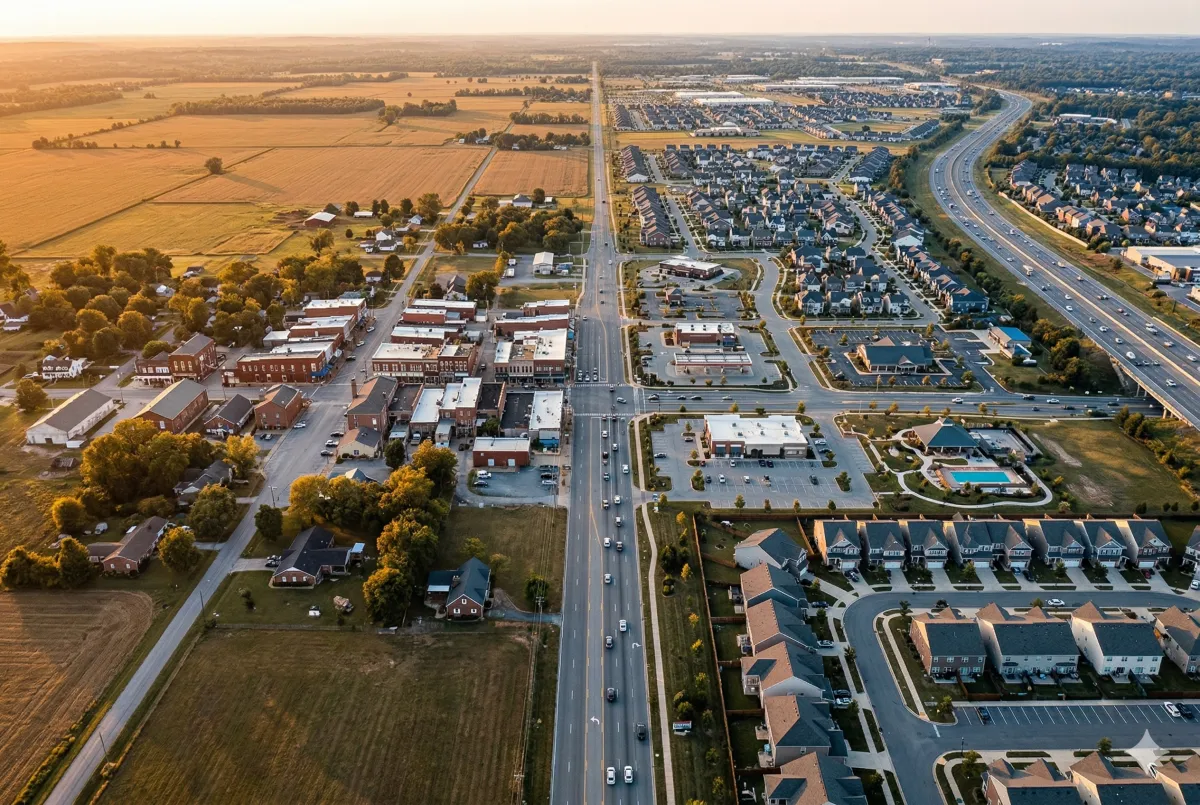
A community that had fewer than 5,000 residents a decade ago is now pushing toward 20,000 — with new residential development approved and under construction that will push that number significantly higher in the next five years. The Columbia Pike corridor connecting Thompsons Station to Spring Hill and Franklin is becoming one of the most active development corridors in all of Williamson County.
New subdivisions with names like Tollgate, Bridgemore, and Tollgate Village are bringing families from Nashville, from out of state, from every direction — people who chose Thompsons Station for the same reasons people chose Spring Hill a decade ago. Space. Community feel. Williamson County schools. A price point that's more accessible than Franklin or Brentwood while still delivering the Middle Tennessee quality of life they were searching for.
Those families are arriving with no established local relationships. They're finding dentists, contractors, HVAC companies, attorneys, and service providers of every kind through AI search — because that's how consumers find local businesses in 2026.
And right now — almost no Thompsons Station businesses are showing up in those AI recommendations.
The Spring Hill Lesson — What the Businesses That Won Did Differently
I want to be specific about what separated the Spring Hill businesses that thrived through the growth wave from the ones that didn't — because that specificity is the roadmap for Thompsons Station businesses right now.
The businesses that won the Spring Hill growth wave shared three characteristics.
They moved before it felt necessary.
The businesses that established digital authority in Spring Hill didn't wait until the chains arrived and the competition intensified. They moved when the growth was just beginning — when the urgency wasn't yet obvious and the competitive pressure wasn't yet intense.
That early movement gave them months — sometimes years — of compounding authority before any competitor had a chance to catch up. By the time the chains arrived and the marketing budgets escalated, those businesses were already the default AI recommendation in their category. Dislodging them required sustained effort and significant investment that most new competitors weren't willing to make.
They claimed their geography before anyone else did.
The Spring Hill businesses that won didn't just optimize for Spring Hill generally. They claimed specific communities within Spring Hill — the neighborhoods, the subdivisions, the corridors where their new customers were arriving. They named those communities in their content, their reviews, their GBP posts, their schema markup.
When a new resident in a specific Spring Hill subdivision asked AI for a local service provider — the business that had explicitly named that subdivision in its digital presence had a geographic specificity advantage that generic "Spring Hill" competitors couldn't match.
They activated their existing customer base before the new customers arrived.
The longtime Spring Hill customers — the families who had been with those businesses for ten and fifteen years — became the review foundation that new residents trusted when choosing local service providers.
The businesses that asked those longtime customers for specific, detailed reviews before the growth wave hit built a review profile that new residents read as deep community trust. The businesses that waited found themselves competing against chain competitors with centralized review generation systems — and losing.
What Thompsons Station Businesses Need to Do Right Now
The Spring Hill lesson is clear. The Thompsons Station window is open. Here's exactly how to use it.
Claim Thompsons Station completely and specifically.
Every piece of your digital presence needs to name Thompsons Station explicitly. Not just "Williamson County." Not just "Middle Tennessee." Thompsons Station. Columbia Pike corridor. Tollgate. Bridgemore. The specific communities where your new customers are arriving.
Geographic specificity in AI search is how your business gets matched against the location-specific queries your new neighbors are asking. Generic geography gets generic results. Specific geography gets specific recommendations.
Activate your existing customer base for review generation immediately.
Your longtime Thompsons Station customers are your most powerful AI search asset right now — and they're a time-sensitive asset. As the community grows and new residents arrive, the ratio of longtime customers to new residents will shift. The window to build a review foundation from your existing customer base — before the growth wave fully arrives — is right now.
Ask every longtime customer this week. Specific prompt. Specific language. Reviews that mention Thompsons Station, Columbia Pike, their specific neighborhood, the specific service you provided, and the specific outcome they experienced.
That review foundation — built from genuine longtime community relationships — is the trust signal that new residents read when they're deciding between a familiar chain and an unfamiliar local business they found through AI search.
Build content that speaks to new Thompsons Station residents specifically.
A blog post titled "New to Thompsons Station? Here's What Williamson County Homeowners Need to Know About Finding Trusted Local Service Providers" captures a new resident at the exact moment they're establishing local relationships — and positions your business as the community authority they should trust.
That hyper-specific content targeting new residents is something no chain competitor will create. Chains create generic content for broad markets. Local businesses can create specific content for specific communities — and that specificity is an AI search advantage chains can't easily replicate.
Implement schema markup that names your communities before the chains do.
When the first chain opens in Thompsons Station — and they're coming — their corporate marketing team will add Thompsons Station to their service area schema within days. You need to have Thompsons Station, Columbia Pike, and the surrounding communities named in your schema markup for months before that happens.
Schema authority compounds over time. The business with six months of established schema signals will outperform a new competitor with freshly implemented schema — even if that competitor has a larger marketing budget.
Post to your GBP every single week. Starting today.
Thompsons Station specific content. Jobs completed in Tollgate and Bridgemore and the Columbia Pike corridor. Photos from real community locations. Review responses that mention Thompsons Station by name.
The weekly GBP posting history you build over the next six months will be a compounding authority signal that new chain competitors simply can't replicate when they arrive.
The Columbia Pike Corridor Opportunity
There's a specific geographic opportunity in Thompsons Station that I want to highlight — because it's unique to this community and represents one of the most concentrated AI search opportunities in the entire Murfreesboro radius.
The Columbia Pike corridor connecting Thompsons Station to Spring Hill and Franklin is becoming one of the most intensely developed commercial and residential strips in all of Middle Tennessee. New businesses are opening. New residential communities are filling in. New residents are arriving from both directions — from Spring Hill moving south and from Franklin moving north.
A Thompsons Station business that builds AI search authority along the Columbia Pike corridor — with content and schema and review language that names this specific geographic corridor — will be positioned to capture customers from both Spring Hill and Franklin's overflow as well as Thompsons Station's own growth.
That corridor positioning is available right now. And it's the kind of geographic specificity that produces disproportionate AI search returns in a high-growth market.
The Choice Every Thompsons Station Business Owner Has to Make
I want to close with the same choice I described at the beginning of this post — because it's real and it's urgent and every Thompsons Station business owner needs to make it consciously rather than by default.
The Spring Hill story has two endings.
The businesses that moved before it felt necessary — that built their digital authority during the early growth wave, that claimed their geography before the chains arrived, that activated their existing customer base before the new residents outnumbered them — those businesses are thriving today. They serve a customer base ten times larger than the one they started with. They're the AI recommendation in their category. They're the first call every new Spring Hill resident makes.
The businesses that waited — that kept doing what had always worked, that assumed the handshake economy would sustain them through the growth wave — those businesses are competing against chain marketing budgets they can't match, in a market that has already decided who the trusted local providers are.
Thompsons Station is at the beginning of that story right now.
The ending hasn't been written yet.
The businesses that move in the next 90 days will write one kind of ending. The ones that wait will have their ending written for them.
Start Here
If you're a Thompsons Station business owner ready to find out exactly where you stand in AI search — and what it would take to establish authority before the growth wave peaks — start with our free AI Visibility Scorecard at corymediagroup.com/ai-scorecard.
No sales pitch. No obligation. Just clarity.
Steve Cory is the founder of Cory Media Group, a digital marketing agency based in Shelbyville, Tennessee, serving businesses across Thompsons Station, Williamson County, and all of Middle Tennessee.